
When Your Customers Rename Your Product: The Story Behind KFC × Chicken Wine

La Vieille Ferme spent decades building a French wine brand. Then customers started calling it “Chicken Wine”. Instead of correcting them, the brand embraced the nickname, and this summer it has led to perhaps the most obvious collaboration imaginable: KFC.

Brands spend an awful lot of time deciding what they want us to call things.
There are naming workshops, positioning exercises, brand guidelines and carefully approved terminology, all designed to make sure customers describe a product in exactly the right way. Then, occasionally, customers ignore all of that and come up with something much better themselves.
That's more or less what happened to La Vieille Ferme.
The French wine from Famille Perrin had already been around for decades when a new generation of drinkers discovered its rosé and started sharing it on TikTok. There was only one slight problem: plenty of them didn't know how to pronounce La Vieille Ferme. What they could recognise was the rather prominent poultry on the label, and so the internet came up with a considerably easier name.
Chicken Wine.
The evolution
Instead of issuing a pronunciation guide and politely steering everyone back towards the proper brand name, La Vieille Ferme did something much more interesting. It embraced it.
Two years later, that customer-created nickname has become powerful enough to underpin a collaboration with KFC, complete with a temporary wine bar in Shoreditch called Coq au Vin. It's funny, slightly ridiculous and one of those partnerships that feels so obvious once you see it that you wonder why nobody thought of it sooner.
But the more interesting story started long before KFC arrived.
Chicken Wine is a brilliant example of what can happen when a brand stops trying to control every part of its identity and starts listening to the language its customers are already using.
How La Vieille Ferme became Chicken Wine
La Vieille Ferme's viral moment began in 2024, when its rosé started attracting attention on TikTok and Instagram.

The appeal wasn't driven by a carefully orchestrated influencer campaign either. Andrew Bayley, managing director of Famille Perrin UK & Ireland, told The Grocer that the growth was “entirely organically driven”, with his own children initially having to show him what was happening online.
The nickname was straightforward enough. La Vieille Ferme isn't particularly easy to pronounce if your French is a little rusty, while the illustrated chickens on the bottle are rather difficult to miss. Calling it Chicken Wine gave customers an easy way to identify it, recommend it to friends and find it again.
And those customers weren't simply talking.
Sainsbury's reported a 96% year-on-year increase in sales of La Vieille Ferme Rosé in 2024 as the wine became a viral hit.
More recent NIQ figures cited by The Grocer put La Vieille Ferme's UK off-trade sales at £190.3 million in the year to 21 March 2026. Its rosé is now the UK's bestselling rosé by both value and volume.
What happened next is where the branding story becomes particularly interesting. Rather than treating Chicken Wine as an amusing internet nickname, Famille Perrin put it on the bottle.
A limited run of 100,000 bottles carrying “The Chicken Wine” branding launched in autumn 2024 and sold out rapidly. The company has continued leaning into the identity since, including putting a much larger chicken silhouette on its newer canned sparkling wines.
Bayley's ambition is surprisingly bold: he believes the chicken could eventually become recognisable enough that the brand name itself isn't always necessary.
For a centuries-old French winemaking family, that's quite a lot of faith to place in a nickname invented on TikTok.
What happens when customers understand your brand differently?
There's an important distinction here between letting customers completely dictate your brand and paying attention when they tell you something useful about it.
La Vieille Ferme hasn't abandoned its heritage, changed its wine or suddenly started behaving like a TikTok novelty brand. What it has recognised is that customers developed their own shorthand for something they already liked. More importantly, that shorthand solved a genuine problem.
“Chicken Wine” is easy to say, easy to remember and immediately linked to one of the product's most distinctive visual assets.
As Bayley puts it, the ownership of the brand sits with consumers as much as the company. His argument is that once customers have affectionately adopted a nickname, correcting them misses the point; they've already formed an emotional relationship with the product.
There's something in that for smaller businesses too. The language customers use naturally isn't always the language businesses use in their marketing. A service might have a formal name on your website while clients consistently describe it in a much simpler way. Customers might love a feature you barely mention, use a product differently from how you expected or latch onto a visual detail you considered relatively unimportant.
Not every observation needs to result in a rebrand, obviously. The internet has produced enough questionable nicknames to make that a fairly dangerous policy. But when the same language keeps appearing organically, particularly when it's affectionate and useful, it's worth asking why.
Sometimes customers are telling you what they actually find memorable about your brand.
And then, inevitably, KFC came along
Once your wine is widely known as Chicken Wine, there is one collaboration that becomes almost impossible to resist.
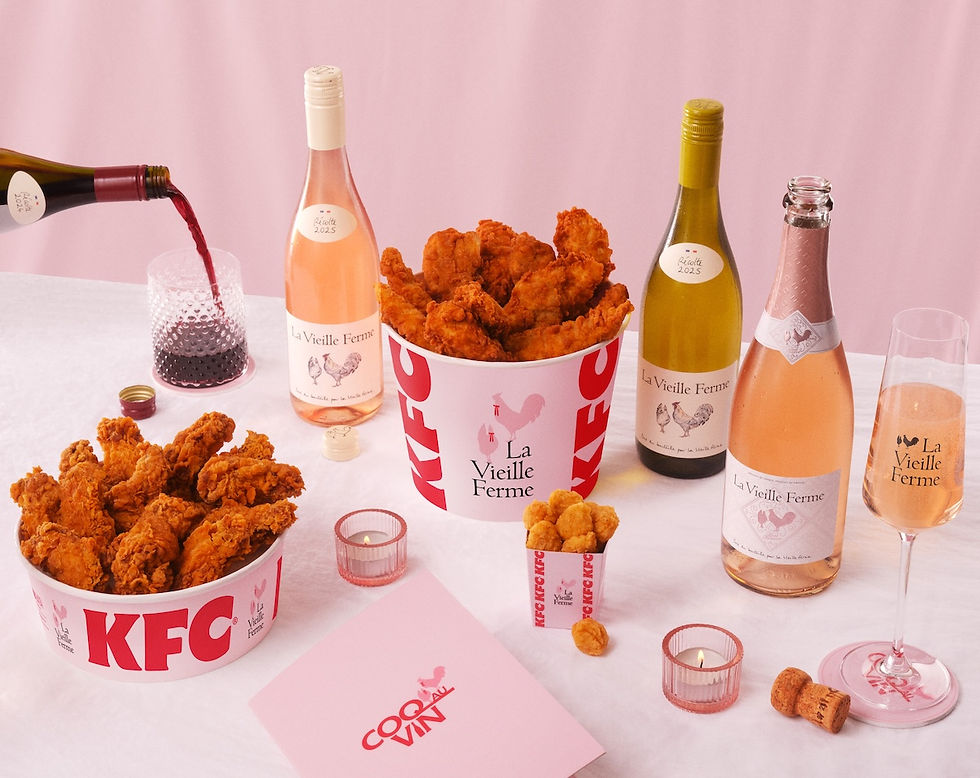
Over the August Bank Holiday, KFC and La Vieille Ferme are bringing Coq au Vin to Shoreditch: a four-day pop-up wine bar serving KFC alongside a selection of La Vieille Ferme wines.
The menu includes Popcorn Chicken with sparkling rosé, Hot Wings with La Vieille Ferme Rouge and Original Recipe Tenders paired with rosé or white wine. The special Chicken Wine label is also returning exclusively for the event.
It's a clever collaboration precisely because it requires very little explaining. KFC does chicken. La Vieille Ferme is Chicken Wine. Put them together and you have Coq au Vin.
KFC's fame and partnerships lead Phoebe Syms has even acknowledged the obviousness of the pairing, saying the partnership “just makes sense” and joking that they can't believe it has taken this long.

That simplicity matters.
Brand collaborations can sometimes feel as though they've been designed backwards, with two companies deciding they want the attention that comes with a partnership and only afterwards working out what they actually have in common.
Here, the shared idea already existed. In fact, customers had spent the previous two years building it for them.
It also gives the Chicken Wine identity somewhere new to go. Instead of simply printing the nickname on another batch of bottles, La Vieille Ferme has turned it into an experience. The joke becomes a physical wine bar, a menu and something people can participate in, extending the customer-created identity without squeezing it dry.
Customer-led branding doesn't mean giving up control
There is, of course, a limit to all this.
Brands need consistency, and handing over every marketing decision to whichever customer comment receives the most likes would probably end badly. The interesting lesson from La Vieille Ferme isn't that businesses should give up control of their brands; it's that control and ownership aren't quite the same thing.
A business controls its logo, website, packaging and campaigns. What it can't completely control is what people think, say and remember once those things enter the real world.
For small businesses, that can actually be an advantage. You're often much closer to your customers than a large organisation is. You hear the questions they ask repeatedly, the words they use to describe what you do and the little jokes or references that emerge around your products. You don't necessarily need a social-listening platform to uncover those insights because they're sitting in emails, reviews, conversations and comments already.
The challenge is noticing when one of them tells you something useful.


Comments