
Pokémon Collaborates With Everyone. So Why Doesn't It Feel Overdone?

Pokémon has spent its 30th anniversary appearing on coffee tins, trainers, doughnuts and several thousand LEGO bricks. Ordinarily, this level of collaboration might start to feel like overkill.
Yet somehow Pokémon keeps getting away with it. So what makes the brand quite so collaboration-proof?

There is, apparently, no object Pikachu cannot improve.
Over the course of Pokémon's 30th anniversary year, the franchise has found its way onto Grind coffee tins, PUMA trainers, Krispy Kreme doughnuts and an expanding collection of LEGO sets. That's before you get into the clothing, reusable cups, accessories and other limited-edition products released along the way.
Normally, this is the point where you might start wondering whether a brand has overdone the collaborations.
Limited-edition partnerships tend to generate attention because they feel special. Announce a new one every other Tuesday and there's surely a danger that the novelty starts wearing thin, with the collaboration itself becoming less of an event and more of a distribution strategy with nicer packaging.
Pokémon, strangely, doesn't seem to have quite the same problem.
Reenergising an iconic brand
Three decades after the first games arrived in Japan, partnerships aren't sitting on the edges of the Pokémon brand; they're one of the ways people experience it.
The Pokémon Company International's licensing programme now stretches across toys, clothing, technology, homeware and designer collaborations, explicitly giving audiences different ways to interact with the franchise.
And perhaps that's the key. Pokémon has something most brands don't: an entire universe built around discovering things, choosing favourites and collecting them.
The more you look at its collaborations, the less they feel like products with Pikachu stuck on them and the more they start to resemble an extension of what Pokémon has always asked its fans to do.

Grind lets you choose your Pokémon
Take the recent collaboration with Grind. The London coffee brand has created a special-edition range starring Pikachu, Eevee and Mew across refillable coffee tins, reusable cups, clothing and ready-to-drink iced coffees.
The collaboration was designed to celebrate Pokémon's 30th anniversary, but there's one detail that makes it particularly interesting: Grind founder David Abrahamovitch says the partnership had been a lhttp://product.Itong-time request from customers.
That's already a fairly good indication that the audience overlap existed before somebody in marketing suggested the collaboration.
But Grind has also incorporated a very Pokémon-like behaviour into the products themselves.
Customers buying the coffee tins don't simply buy a Pokémon tin; they're asked “Who will you choose?”, with Pikachu, Eevee and Mew available alongside their preferred coffee. New coffee subscribers can also receive one of the limited-edition tins with their deliveries, tying the collectable element directly into Grind's recurring subscription product. It's a tiny detail, but a clever one.
PUMA turns characters into design language
PUMA's 2026 collaboration takes the franchise somewhere completely different.
Rather than simply covering its trainers in Pokémon graphics, the sportswear brand built its 30th-anniversary collection around a sun and moonlight theme, using Espeon and Umbreon to inspire contrasting daytime and nighttime colourways.

The characters influence the designs of the Mostro and Fade Nitro trainers, while Pikachu gets its own interpretation through a yellow All-Pro NITRO 2 basketball shoe featuring lightning-inspired details.
The distinction might sound small, but it's important.
PUMA is still recognisably PUMA. Pokémon hasn't swallowed the product whole; its characters and visual world have given the sportswear brand material it can reinterpret through its own design language.
That's often where brand collaborations become more interesting. The least memorable examples tend to feel like a licensing exercise: take existing product, apply famous character, await sales. The stronger ones give both brands something to contribute, so the finished product couldn't quite have come from either of them independently.
PUMA gets access to Pokémon's characters and enormous cultural recognition. Pokémon gets translated into a fashion and sportswear language it wouldn't naturally create on its own. Everyone goes home with considerably more Pikachu.
LEGO feels almost suspiciously obvious
Then there's LEGO, a collaboration that prompts a slightly different question: how did this take 30 years?
The two brands fit together almost too neatly. Pokémon is built around discovering creatures, collecting them and building a team, while LEGO revolves around collecting pieces and building things.
Both have enormous adult fanbases alongside the children they were originally created for, and both have managed to turn play into something people continue enjoying long after they're technically supposed to have grown out of it.
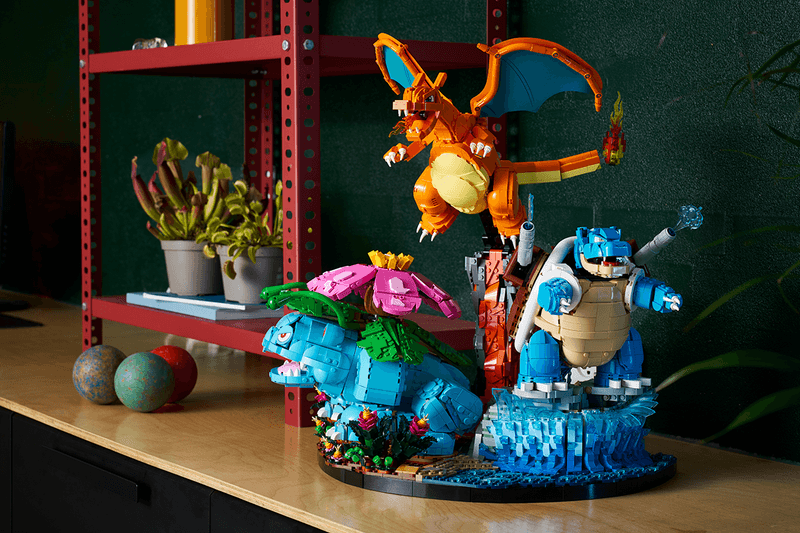
Their partnership has expanded significantly during 2026. New sets announced this summer include buildable versions of Rayquaza, Arcanine and Munchlax, alongside a large Poké Ball set recreating moments from a Pokémon Trainer's journey. LEGO also announced twelve SMART Play Pokémon sets designed to let children explore, train, nurture and battle through interactive builds.
This is perhaps the clearest example of why the best Pokémon partnerships feel like more than merchandising.
LEGO isn't simply borrowing a recognisable character. It's taking an existing Pokémon experience and translating it into something LEGO is uniquely equipped to provide. Fans can physically build the creatures and environments they've previously encountered through games, cards and animation.
The partner brings something to the Pokémon universe rather than simply borrowing attention from it.
Krispy Kreme turns buying doughnuts into collecting
And then there are the doughnuts.
This August, Krispy Kreme's UK Pokémon collection has turned Pikachu, Charmander, Jigglypuff and the Poké Ball into limited-edition doughnuts, with flavours and decoration designed around each one. Pikachu gets lemon sherbet, Charmander gets dulce de leche and marshmallow, while Jigglypuff is, predictably enough, extremely pink.
The campaign language does plenty of heavy lifting too. Krispy Kreme asks customers which doughnuts they're “catching first” and describes the limited-edition dozen as something worth catching while it's available. It's hardly subtle.

But then Pokémon has never been particularly coy about the collecting part.
The UK launch has even included mystery boxes containing a randomly selected character doughnut, with further mystery Pokémon planned for September. Suddenly buying a doughnut borrows a tiny bit of the experience of opening a pack of Pokémon cards: you know roughly what you're getting, but there's still an element of discovery involved.
Once again, the partner isn't only borrowing Pokémon's visual identity. It's borrowing a behaviour from the world around it. And that's where the strategy starts becoming much more interesting.
Pokémon gives brands more than characters to play with
Pokémon has an almost unfair advantage when it comes to collaborations because there isn't really one singular Pokémon aesthetic.
There are more than 1,000 Pokémon, each with different colours, personalities, types and fanbases. There are games, trading cards, animation, apps, merchandise and competitive events, creating numerous different ways into the same franchise.

The Pokémon Company's licensing strategy reflects that breadth. It describes a programme spanning everything from toys and clothing to technology and home décor, while the Pokémon Trading Card Game alone has spent decades building a culture around collecting.
That gives collaborators an enormous creative playground.
Grind can focus on choosing a favourite.
PUMA can use characters as design inspiration.
LEGO can turn Pokémon into something people build and play with.
Krispy Kreme can recreate the experience of catching and collecting.
All four are borrowing Pokémon, but they're not borrowing the same bit. That may be the real reason the sheer volume of collaborations hasn't become completely exhausting. Pokémon doesn't just give partners a logo and a collection of famous characters. It gives them an established set of behaviours to work with: choosing, collecting, discovering, battling, trading and completing a set.
Those behaviours are flexible enough to travel surprisingly far. Even, apparently, into doughnuts.
Surely there is such a thing as too much Pokémon?
There is still a risk here. Pokémon might be unusually collaboration-friendly, but it isn't immune to overexposure. If every product in every shop suddenly arrives with a Pikachu attached, individual partnerships inevitably become less noteworthy. What once felt like an event starts becoming background noise.
And not every collaboration will have the depth of LEGO or the natural customer overlap of Grind.
That's probably where the distinction between brand fit and simple brand recognition becomes important. A collaboration can generate sales because a character is famous without necessarily adding anything interesting to either brand.
The stronger examples answer a more demanding question:
What can this partner do with Pokémon that Pokémon wouldn't do quite as well on its own?
LEGO can let you physically build it. PUMA can translate it into sportswear. Grind can bring it into an everyday coffee ritual. Krispy Kreme can turn choosing characters into something edible.
The character on the product might get someone's attention. But the interaction between the brands is what makes the collaboration worth remembering.
Can you take some inspo?
For most small businesses, the lesson from Pokémon probably isn't to announce six new collaborations before Christmas.
It's to think more carefully about what a collaboration is actually supposed to create.
You don't need a globally recognised entertainment franchise on the other side of the partnership. It could be a local illustrator working with an interiors shop, a bakery teaming up with a coffee roaster or two independent businesses whose customers already overlap.


Comments