
What's Happened in Marketing in August 2026? Major News, Trends & Campaigns

August is usually supposed to be one of the quieter months in marketing.
Half the industry is on holiday, inboxes are filled with out-of-office replies, and everyone collectively agrees that anything non-urgent can probably wait until September.
Apparently, nobody told the brands.
This month we've seen KFC turn a customer-created wine nickname into a real-world collaboration, Aldi attempt to solve the surprisingly serious problem of choosing the wrong shade of rosé, and Busch replace traditional billboards with hay bales in Saskatchewan. Meanwhile, LinkedIn has continued its battle against AI slop, and Pokémon has found its way onto everything from coffee tins to iced lattes.
Here's what caught our attention.
KFC finally makes Chicken Wine official
Sometimes customers hand you a marketing idea so good that the sensible thing to do is simply run with it.
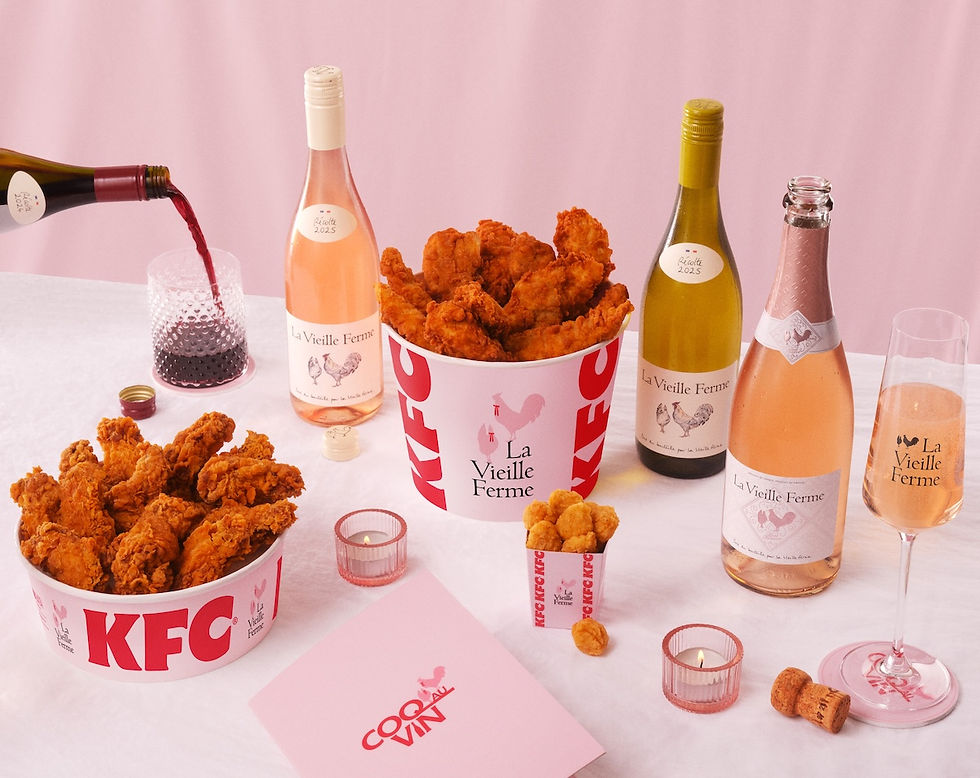
La Vieille Ferme has long been affectionately known as "Chicken Wine" by British drinkers because of the rooster on its label. Rather than correcting everyone on the proper French name, the brand has increasingly embraced the nickname, and this August it took things to their logical conclusion by partnering with perhaps the world's most famous chicken brand.
KFC and La Vieille Ferme are opening a four-day Coq au Vin pop-up wine bar in Shoreditch over the August Bank Holiday, where KFC classics will be paired with different wines from the range.
La Vieille Ferme is even bringing back its Chicken Wine label specifically for the occasion.
It's a collaboration that manages to feel both ridiculous and completely inevitable. More importantly, it's a brilliant example of what can happen when brands loosen their grip on how customers are "supposed" to talk about them. La Vieille Ferme didn't create the Chicken Wine identity; its customers did. By embracing it rather than resisting it, the brand has turned an affectionate nickname into something it can genuinely own.
Jamiroquai brings Virtual Insanity back for Beefeater 0.0%
If you grew up watching MTV, this one may make you feel approximately 400 years old.
Beefeater has teamed up with Jamiroquai frontman Jay Kay to recreate the band's iconic Virtual Insanity video, almost 30 years after the original was released in 1996.
This time, however, the moving floors and famous hat are being used to introduce Beefeater 0.0%, the gin brand's alcohol-free alternative. There's a commercial reason behind the nostalgia.
Pernod Ricard says 75% of Beefeater 0.0% shoppers are new to the Beefeater brand, while 15% subsequently go on to buy its traditional London Dry gin.
In other words, the alcohol-free product isn't simply serving existing customers who want to drink less; it's introducing an entirely new audience to Beefeater.
That's what makes the throwback interesting. Nostalgia marketing can quickly become a brand replaying its greatest hits because it has nothing new to say. Here, something familiar is being used to make a newer product feel culturally relevant. It's not just remember this? There's a reason for bringing it back.
LinkedIn would quite like us to stop posting AI slop
There's a certain irony in watching technology platforms spend several years encouraging everyone to use AI, only to discover that people using AI for absolutely everything might not produce the most interesting internet.
LinkedIn has been increasingly vocal about what it calls "AI slop": generic, repetitive content produced with little meaningful human input. The platform says its detection systems can now correctly identify generic content 94% of the time, and posts it suspects of being low-effort AI content are less likely to travel beyond someone's immediate network.

It has now gone a step further by giving users a "Seems like AI slop" reporting option. According to recent reporting, more than one million people have already used it, while suspected AI-generated content is seeing significantly reduced visibility.
Importantly, LinkedIn isn't saying businesses shouldn't use AI. Its own guidance explicitly says AI can be useful for refining language, but that the final post still needs to contain a real perspective. For anyone using AI to create content, that's an important distinction. The problem isn't necessarily how the first draft was produced; it's whether there's anything recognisably human left by the time you press publish.
Aldi creates a Pantone chart for rosé drinkers
Apparently, we've all been buying rosé wrong.
Aldi commissioned research into how British shoppers choose rosé and discovered that 56% consider colour when selecting a bottle, while 31% have actually rejected a glass because it wasn't the right shade. Aldi estimates that our collective rosé colour preferences result in more than £103 million worth of wine being rejected every year.
Its solution is wonderfully Aldi: a limited-edition Rosé Swatch keyring, featuring colours inspired by bottles in its range so drinkers can identify their preferred shade before committing.

There's obviously an element of silliness to the idea, but that's what makes it work. Instead of simply announcing its summer wine range, Aldi has found an oddly specific consumer behaviour and turned it into something visual, useful and inherently shareable.
The campaign also feels unmistakably like the brand: accessible, slightly cheeky and very aware that nobody needs choosing a bottle of rosé to become too serious.
Busch turns Saskatchewan hay bales into billboards
Some outdoor campaigns work because they interrupt their surroundings. Busch's latest campaign works because it becomes part of them.
Rather than buying traditional billboard space to promote its Farmer's Pack in Saskatchewan, Busch Canada has wrapped giant hay bales to look like oversized beer cans, creating what the brand has rather inevitably called "Baleboards". The installations sit alongside fields near Rosetown and Biggar, including fields used to grow barley for the beer itself.

The cleverest part isn't necessarily the giant cans, though. Busch is paying participating farmers what it would otherwise have spent on conventional billboard placements, putting some of its advertising budget directly into the communities the campaign is celebrating.
Saskatchewan is also a significant source of barley for Labatt, with around 85% of the barley used by its breweries grown in the province.
It's a lovely example of media placement becoming part of the creative idea rather than something decided once the campaign is finished. A photograph of a beer can on a city billboard could belong to almost any brand. A giant Busch can sitting in the field that helped produce it tells a much better story.
Grind gives Pokémon a caffeine hit
Pokémon turns 30 this year, which is another fact we're choosing not to dwell on for too long.
To mark the anniversary, London coffee brand Grind has launched a special-edition Pokémon collection featuring Pikachu, Eevee and Mew across coffee tins, reusable cups, apparel and ready-to-drink iced coffees. The products are available online, in selected Grind locations and, for some of the canned drinks, through supermarkets including Sainsbury's, Waitrose and Co-op.
There are plenty of nostalgia-driven brand collaborations around at the moment, but one detail makes this particularly interesting: Grind says the Pokémon partnership has been a long-time request from its own customers.

That immediately makes the collaboration feel less like two brands being randomly placed next to one another and more like something the audience already wanted. It also shows how powerful nostalgia becomes when brands understand who they're speaking to.
Plenty of Grind's millennial customers grew up with Pokémon; now they have adult money and, more importantly, an adult dependence on coffee. It's difficult to imagine a more convenient meeting point.
Our thoughts
Looking across this month's campaigns, we're less interested in the individual gimmicks than in what they have in common.
KFC didn't invent the Chicken Wine nickname. Grind didn't manufacture people's affection for Pokémon. Beefeater didn't create nostalgia for Virtual Insanity, and Busch didn't need to invent a connection with Saskatchewan's farming communities. Each brand found something that already mattered to its audience and built the marketing around it.
Even LinkedIn's AI update points in a similar direction.
As producing polished-looking content becomes easier, having something original to say becomes more valuable. The technology might be changing rapidly, but the marketing principle underneath it feels remarkably familiar: pay attention to people.
For small businesses, that's quite reassuring. You don't necessarily need the biggest budget, the newest technology or a campaign idea nobody has ever seen before. Sometimes the most interesting marketing opportunities are already sitting in customer conversations, purchasing habits, community connections and the slightly strange things people do with your products.


Comments